

Not long ago, bare walls and neutral palettes were the gold standard of modern living. The rule was simple: less is more. But something shifted. Homes started feeling cold, interchangeable, and a little soulless. Today, people are filling their spaces with handmade treasures, folk-inspired accents, and one-of-a-kind pieces that say something real about who they are. This guide walks you through why that shift is happening, what forces are driving it, and exactly how you can bring that same energy into your own home with confidence and intention.
Table of Contents
- From minimalism to lived-in storytelling: The trend explained
- Drivers of the trend: Self-expression, technology, and sustainability
- Handmade, “folklectic,” and whimsical: Rejecting mass production
- How to apply unique decor: Practical tips and common pitfalls
- A fresh perspective: Beyond trends, designing your story
- Explore curated unique decor and handmade gifts
- Frequently asked questions
Key Takeaways
| Point | Details |
|---|---|
| Personal storytelling matters | Modern decor now centers around expressing your story and personality instead of following sterile trends. |
| Handmade and sustainable edge | Unique decor choices often support local artisans, use eco-friendly materials, and reduce waste. |
| Balance creativity and editing | Personalization is powerful, but editing your decor ensures cohesion and avoids visual overload. |
| Technology drives accessibility | AR and 3D printing allow for custom decor at home, making unique pieces more achievable. |
From minimalism to lived-in storytelling: The trend explained
Minimalism had a great run. Clean lines, monochrome palettes, and clutter-free surfaces made a lot of sense in a world that felt overwhelming. The problem is that stripping everything away eventually strips out personality, too. A home that looks like a hotel lobby might photograph well, but it rarely feels like a place where real life happens.
That’s exactly why the shift from minimalism to personalized, lived-in spaces is gaining momentum right now. People want spaces that feel layered and meaningful, filled with objects that hold memories, reflect values, and spark conversation. Decor is no longer just about visual calm. It’s about telling your story.
Design experts are calling this new direction “narrative maximalism,” and it’s a real departure from what came before. A survey of 100 designers found that whimsical and eclectic decor styles, featuring handmade accents, bold colors, and layered patterns, are now among the most requested by clients. The demand is coming from real people who are tired of spaces that feel curated by algorithm rather than lived in by humans.
Here’s what the shift looks like in practice:
- Before: White walls, sculptural furniture, nothing on the shelves except one perfectly placed plant.
- Now: Textured throws, hand-thrown ceramics, inherited quilts, and shelves stacked with meaningful objects.
- Before: Every piece from the same big-box retailer, matching down to the hardware.
- Now: A mix of old and new, mass-market and artisan, global and local.
There’s even a middle ground for those who still love simplicity. Warm minimalism blends honest textures like linen, wood, and ceramic with genuine emotional warmth. It avoids clutter but makes room for pieces that actually matter. It’s the bridge between the two worlds, and it’s where a lot of people are landing right now.
“Your home should look like you collected it over a lifetime, not like you bought everything in one afternoon.” This idea captures why narrative-driven decor resonates so deeply with people right now.
If you’re curious about where to start, personalizing your decor doesn’t require a total overhaul. Small, intentional choices go a long way. Think of it like writing a book one page at a time. Browsing artisan home decor is a great way to find pieces that feel personal from the very first glance.
Drivers of the trend: Self-expression, technology, and sustainability
So why is this happening now? The answer isn’t just cultural. It’s economic, technological, and deeply personal all at once.
The numbers tell a compelling story. The personalized decor market is growing at a 7.2% compound annual growth rate (CAGR), expanding from USD 165.4 billion in 2024 to a projected USD 330.6 billion by 2034. That kind of growth doesn’t happen by accident. It’s powered by real shifts in consumer behavior and expectations.
Here are the key forces at work:
- Self-expression: People increasingly use their homes as a canvas for identity. In a world where so much looks the same on social media, a truly personal space feels like a quiet act of rebellion.
- Augmented reality (AR) tools: Apps that let you preview furniture and art in your actual space have made personalized shopping dramatically less risky and more accessible.
- 3D printing: Custom decor objects that would have required a skilled craftsperson can now be produced in small batches, lowering the cost of unique design.
- Sustainability awareness: Shoppers are increasingly scrutinizing where their things come from and how they were made. Handmade often wins on both fronts.
| Growth driver | Impact on decor market |
|---|---|
| Self-expression demand | Fuels demand for one-of-a-kind pieces |
| AR technology | Makes custom decor easier to preview and buy |
| 3D printing | Lowers cost of small-batch unique production |
| Sustainability | Shifts preference toward handmade, eco-conscious items |
The sustainability angle deserves special attention. Mass-produced decor generates significant waste, relies on cheap synthetic materials, and often travels halfway around the world before landing on a shelf. Handmade items tend to use natural, biodegradable, or recycled materials. They support local artisans and cultural traditions that might otherwise disappear.
Pro Tip: When shopping for unique handmade gifts or decor, look for pieces made with natural materials and sold by small-batch makers. You get a better product and a cleaner conscience. If you’re looking for artisan decor alternatives to the usual big-box options, there are more choices than ever before.
Handmade, “folklectic,” and whimsical: Rejecting mass production
If one word captures the spirit of where home decor is headed in 2026, it might be “folklectic.” It’s a blend of folk-inspired design and eclectic layering that draws from traditional craft traditions, especially primitive American motifs, vintage textiles, and rustic handwork.
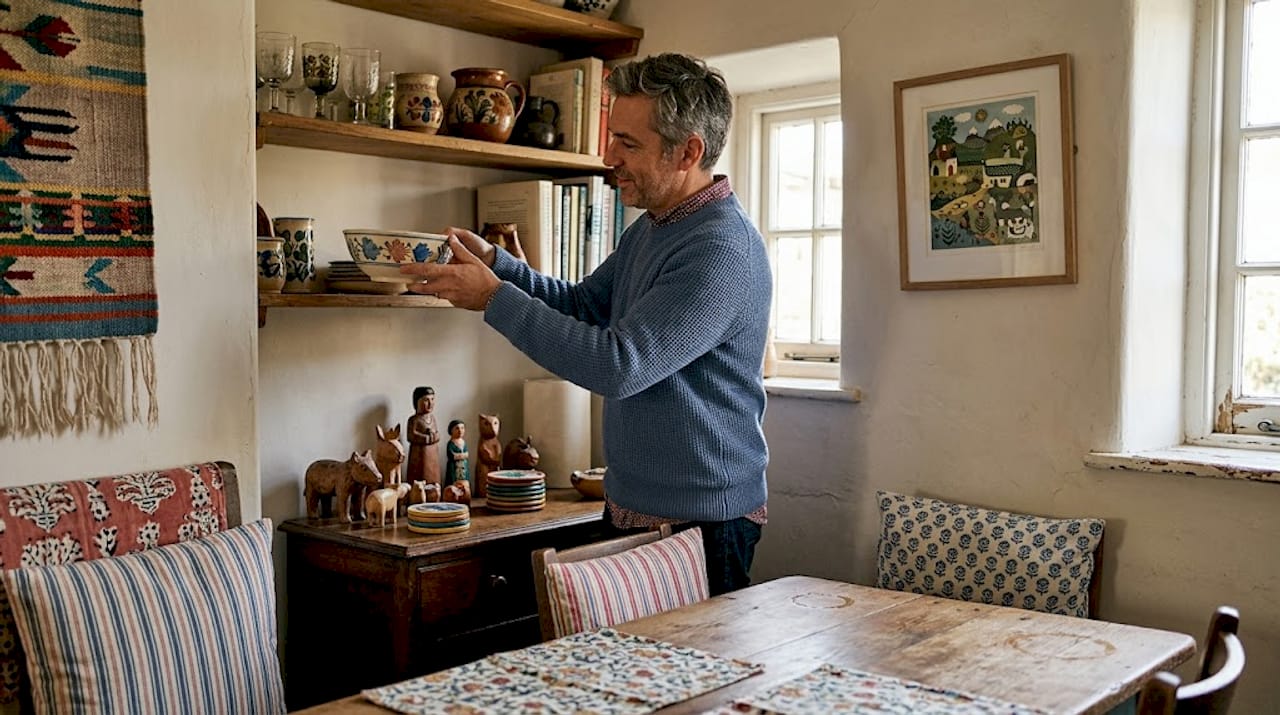
The rise of the folklectic trend is a direct response to the era of fast furniture. Shoppers who are tired of seeing the same particleboard bookshelf in every apartment are turning toward hand-painted pottery, braided rugs, vintage quilts, and carved wooden objects that carry a sense of history and humanity. These are pieces that didn’t come off an assembly line. They came from someone’s hands.
Whimsical maximalism sits in the same family. It embraces eclectic patterns, unexpected color combinations, and textures that invite you to reach out and touch them. A room done in this style might feature a hand-blown glass decanter alongside a bold vintage print, a woven wall hanging, and a painted ceramic bowl on a reclaimed wood shelf. It sounds like a lot, but when done with intention, it feels completely coherent.
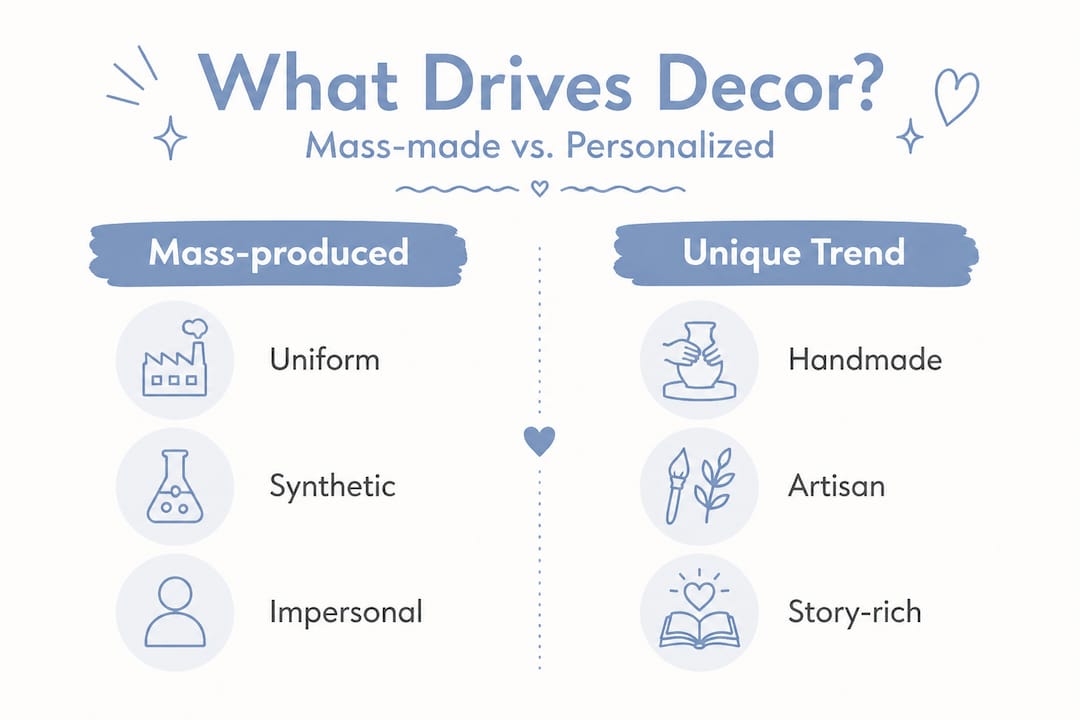
Here’s how handmade and mass-produced decor compare in practical terms:
| Factor | Handmade decor | Mass-produced decor |
|---|---|---|
| Craftsmanship | Individual, variable, unique | Uniform, machine-made |
| Sustainability | Natural materials, lower waste | Synthetic, high waste |
| Emotional impact | High, personal, story-driven | Low, interchangeable |
| Availability | Limited, often one-of-a-kind | Mass supply, widely available |
| Price point | Higher per piece, longer lasting | Lower entry price, faster wear |
The key qualities to look for in folklectic decor include:
- Hand-painted motifs and painted finishes that show the maker’s touch
- Vintage or antique textiles like quilts, embroidered linens, and braided rugs
- Natural materials like wood, clay, stone, and wool
- Objects that reference cultural craft traditions
- Pieces that look better with age rather than worse
If you’re drawn to this aesthetic, vintage decor styling is a fantastic starting point. You can layer in individual pieces over time rather than buying a whole room at once. Something like an olive green hand-painted ceramic box or a hand-blown crystal decanter with artisan painted details can anchor an entire shelf without overwhelming it.
Pro Tip: Folklectic works best when you treat it like a recipe. You want a variety of textures, time periods, and origins, but you still need a through-line. Pick one dominant color or material and let that tie the mix together.
How to apply unique decor: Practical tips and common pitfalls
Knowing why the trend is happening and what it looks like is one thing. Actually pulling it off in your own home is another. The good news is that applying unique decor is less about following rules and more about making decisions with intention.
Start with these steps:
- Identify your story. Before buying anything, ask yourself what you want your space to communicate. Travel, craft, family history, a specific color era? Having a loose narrative helps every purchase feel purposeful.
- Choose one anchor piece. Start with a single statement item, like an heirloom rug, a piece of art, or a hand-thrown ceramic vase, and build from there. This prevents the space from feeling like a shopping cart accident.
- Layer in texture gradually. Add depth through textiles, natural materials, and varying surface finishes. Combine rough and smooth, matte and reflective.
- Edit ruthlessly. After adding pieces, step back and remove anything that doesn’t contribute to the story or that competes too hard for attention.
- Let it evolve. Great spaces aren’t finished. They grow and change as you do.
According to decor experts, the balance between personalization and editing is what separates a curated, expressive space from one that just feels chaotic. The goal is to focus on quality pieces that carry a narrative rather than filling every surface to prove a point.
“The most interesting rooms aren’t decorated all at once. They accumulate meaning over time, the way a great bookshelf does.” This expert perspective is a helpful reminder that patience is one of the best decor tools you have.
Here are the most common pitfalls to avoid:
- Overstyling. Covering every surface and wall leaves nowhere for the eye to rest. White space is not wasted space.
- Lack of cohesion. Even eclectic spaces need a connecting thread, whether that’s a color, a material, a mood, or a time period.
- Ignoring function. A beautiful object that makes your daily life harder is not a good decor choice. Beauty and practicality can coexist.
- Trend-chasing. Buying something because it’s on every design blog this season often means it will feel dated by next season.
- Forgetting lighting. Even the most beautiful decor pieces look flat under harsh overhead lighting. Warm, layered lighting transforms a space.
For deeper guidance on avoiding these mistakes, the decor personalization tips on the My House by Marine blog give you concrete strategies for making choices that hold up over time. And if you want a complete picture of how unique decor can transform your space through small but impactful additions, that guide is worth bookmarking.
A fresh perspective: Beyond trends, designing your story
Here’s something most decor articles won’t tell you: the trend toward unique, handmade, personalized decor is not really about decor at all. It’s about identity. And identity doesn’t follow a trend cycle.
The real trap isn’t buying mass-produced furniture. It’s swapping one version of trend-following for another. First, everyone goes minimal. Then everyone goes folklectic. The people who end up with truly beautiful homes are the ones who slow down long enough to ask what actually resonates with them, not what’s being featured on design blogs this month.
That’s a harder question than it sounds. But the answer lives in the details. Which objects do you keep for years without ever questioning whether to keep them? Which gifts do you reach for first when you want to show someone you really see them? What textures make you want to linger in a room? The answers to those questions are the foundation of a space that feels genuinely yours.
Meaningful home decor personalization is not a one-time project. It’s an ongoing practice of paying attention to what resonates and letting go of what doesn’t. The best rooms carry a mix of pieces collected across different stages of life, each one chosen because it earned its place.
The same logic applies to gift shopping. A handmade, artisan piece given with intention lands differently than a generic gift card or a boxed set from a department store. When you give someone a truly one-of-a-kind object, you’re saying you thought about who they actually are. That matters.
Invest in fewer things and choose them more deliberately. That’s the simple principle behind every great interior you’ve ever walked into and never wanted to leave.
Explore curated unique decor and handmade gifts
Ready to move from inspiration to action? The pieces that make a home feel genuinely personal don’t have to be hard to find.
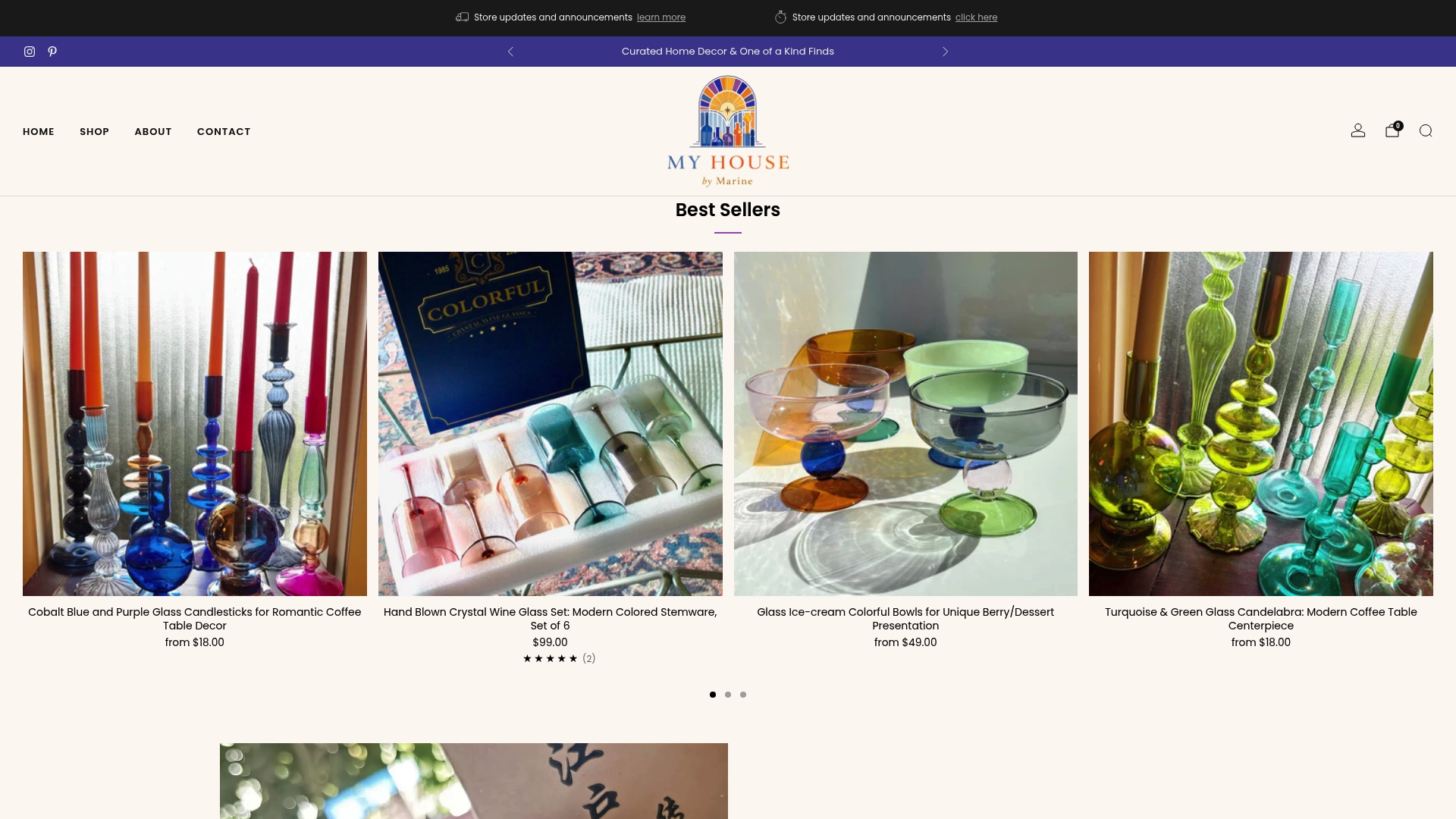
At My House by Marine, you’ll find curated artisan gift sets that are genuinely one-of-a-kind, along with an entire collection of handmade decor pieces designed to add personality and warmth to any space. Whether you’re treating yourself or shopping for someone whose home you want to honor, the selection is thoughtful and distinctive. Explore our artisan glassware for a contemporary luxury touch, or browse the full unique home decor collection to find pieces that tell a real story. Every item is chosen because it earned its place.
Frequently asked questions
What makes unique decor different from mass-produced items?
Unique decor prioritizes craftsmanship, personality, and eco-friendly materials, while mass-produced pieces reject human storytelling in favor of speed and uniformity, losing the emotional resonance that makes a space feel personal.
How can I incorporate unique decor without overwhelming my space?
Edit and curate your selections to focus on quality pieces that contribute to a clear narrative. As decor experts advise, balancing personalization with restraint keeps a space expressive rather than chaotic.
Why is sustainable handmade decor becoming popular?
Handmade decor uses eco-friendly materials, generates less waste, and supports local artisans, all factors that resonate with shoppers who want their purchases to align with their values and have a lower environmental footprint.
What technology is influencing unique decor trends?
AR and 3D printing are making custom personalized decor far more accessible. The 7.2% CAGR growth in the personalized decor market is directly tied to these tools lowering the barrier to entry for one-of-a-kind design.
Recommended
- Top ways to personalize home decor for a unique touch – My House by Marine
- Unique Home Decor Guide: Transform Your Space in 5 Steps – My House by Marine
- Transform your home with accent pieces for style – My House by Marine
- Modern house decor: essential principles and fresh ideas – My House by Marine

